Buyer appointment setting for Wineries Exhibiting in China
Master buyer appointment setting for wineries exhibiting in China. Learn strategic 10-week outreach workflows, channel-specific qualification, and commercial negotiation tactics to secure verified B2B importers.
For international wineries, exhibiting at a Chinese wine trade show without a pre-scheduled meeting calendar is one of the costliest commercial mistakes. Relying strictly on drop-in foot traffic frequently yields casual tasters, service vendors, and regional sub-distributors lacking direct import licenses. To secure meaningful commercial distribution, producers must treat an exhibition booth not as a storefront, but as the final closing room for a structured 10-week pre-fair outreach campaign.
Implementing a systematic approach to buyer appointment setting for wineries exhibiting in china enables producers to engage verified importers, regional wholesalers, retail category buyers, and on-premise hospitality operators well before setting foot in the exhibition hall. By qualifying commercial capabilities, aligning pricing architecture, and securing advance commitments, brands can transform their participation into measurable export contracts.
The Commercial Case: Why Pre-Booked Appointments Dictate Exhibition ROI
China's imported wine sector has evolved into a value-driven, highly discerning marketplace. According to the USDA Foreign Agricultural Service (FAS) 2025 Wine Market Update, China's wine imports reached approximately $1.6 billion in 2024, characterized by intensifying competition among leading producer nations such as Australia and France. Meanwhile, data from the General Administration of Customs China (GACC) reported import volumes stabilizing at 76.37 million liters in early 2024. In this competitive climate, established importers no longer roam aisles indiscriminately; their schedules are booked weeks in advance.
Wineries that rely solely on passive hall traffic face significant commercial disadvantages:
- Low Conversion Rates: Casual visitors often lack import licenses (Customs registration and CIQ clearances) or the capital required to purchase full-container loads.
- Inefficient Time Allocation: Key decision-makers spend valuable show hours repeating basic brand introductions to low-intent attendees rather than conducting detailed portfolio tastings with accredited buyers.
- Compromised Follow-Up: Unscheduled meetings rarely provide sufficient operational clarity regarding distribution channels, making post-event communications sluggish and transactional.
Securing pre-booked appointments guarantees your commercial team meets buyers who possess dedicated warehouse infrastructure, compliant distribution channels, and immediate portfolio vacancies.
Profiling and Segmenting Chinese Wine Buyers
Successful meeting outreach requires precise categorization. Chinese beverage distribution channels operate across distinct business models, each with specific margin requirements, volume expectations, and portfolio needs.
+-----------------------+--------------------------+----------------------------+
| Buyer Category        | Target Portfolio Fit     | Commercial Priority        |
+-----------------------+--------------------------+----------------------------+
| National Importers    | Scalable SKUs, OEM lines | Margin cushion, exclusivity|
| Regional Wholesalers  | Mid-tier estate labels   | Fast regional turnover     |
| Premium HoReCa        | High-score boutique reds | Sommelier training support |
| Direct Retail/E-Com   | Dynamic whites, organics | Streamlined digital assets |
+-----------------------+--------------------------+----------------------------+
1. National Direct Importers
These organizations handle national customs clearance, regional warehousing, and nationwide Tier-1 to Tier-3 wholesale networks. They require stable supply chains, substantial marketing support allowances, and exclusive mainland distribution agreements. When pitching national importers, focus on supply continuity, bulk logistics feasibility, and competitive Ex-Works (EXW) or Free on Board (FOB) pricing structures.
2. Regional Wholesalers & Second-Tier Distributors
Operating predominantly in economic hubs across East and South China (such as Guangdong, Zhejiang, and Jiangsu), these buyers frequently purchase from primary importers or look to import directly to capture wider margins. They prioritize commercially accessible profiles with rapid stock turn, distinctive packaging, and regional marketing collateral.
3. Modern On-Premise & Specialty Hospitality Groups
China’s premium dining scene, specialized wine bars, and boutique hospitality groups actively source boutique, biodynamic, and estate-bottled wines. These buyers rarely order multi-container volumes initially; instead, they seek distinctive regional identities, high international critic scores, and staff education assistance.
4. Retail Category Managers and Social Commerce Aggregators
Major retail platforms—ranging from premium physical club stores like Sam's Club and Costco China to social commerce livestreams on Douyin and Xiaohongshu—focus on rapid shelf velocity. As noted in the USDA FAS 2025 Report, retail giants increasingly engage in direct self-sourcing. Pitching these buyers requires verified production capacities, clear consumer price indexing, and digital marketing assets ready for omnichannel execution.
The 10-Week Pre-Show Outreach Timeline
Securing confirmed appointments requires a phased, disciplined schedule starting two to three months prior to the event.
Week T-10 to T-8: Database Assembly & Channel Segmentation
Week T-7 to T-5: Initial B2B Outreach & Value Proposition Delivery
Week T-4 to T-3: Meeting Confirmation & Sample Coordination
Week T-2 to T-1: Logistics, Schedule Locking & WeChat Integration
Show Days: 30-Minute Structured Booth Meetings
Weeks 10–8: Prospect Qualification and Database Assembly
Identify potential importers that already carry non-competing labels from your country or region. Build a targeted database comprising 100–150 qualified buyer profiles. Review corporate registrations, verify their import qualifications under GACC Decrees 248 and 249, and assess their active channels (on-trade vs. retail).
Weeks 7–5: Cold Engagement and Value Proposition Delivery
Initiate multi-channel outreach. Begin with tailored B2B introductory emails accompanied by bilingual digital product decks (一页纸品牌介绍). Follow up through direct B2B messaging platforms. Emphasize distinct commercial advantages: supply consistency, origin certification, shelf-life integrity, and tailored commercial margins. If you are participating via dedicated event business matchmaking platforms, integrate your profiles to access vetted attendee directories early.
Weeks 4–3: Diary Confirmation and Sampling Alignment
Convert interest into firm appointments. Confirm specific meeting times, allocate a dedicated tasting table, and cross-reference which SKUs the buyer wishes to sample. Ensure that your exhibition samples have cleared Chinese customs inspections—including labeling and phytosanitary verification—as outlined by Beverage Trade Network import compliance standards.
Weeks 2–1: Final Logistics and WeChat Connectivity
Transition all confirmed attendees to WeChat corporate communication threads. Provide buyers with your precise booth location, hall coordinates, and a digital invitation card. Reconfirm meetings 48 hours prior to the show to minimize no-show risks.
Digital Tools and Channel Communication: WeChat & B2B Matchmaking
Western B2B sales development relying solely on email or LinkedIn will underperform in China. Successful commercial execution requires local digital channels:
- Enterprise WeChat (WeCom): WeChat is the primary operating system for Chinese business. Maintain a dedicated corporate WeChat account featuring your bilingual portfolio, digital sell-sheets, pricing matrices, and direct links to book meeting slots.
- Bilingual Sell-Sheets: Ensure all technical fact sheets, appellation overviews, tasting notes, and logistical data (cases per pallet, container loading configurations) are translated into accurate, simplified Chinese by professional industry translators.
- Exhibition Matchmaking Tools: Maximize organizer-led matchmaking systems. Exhibitors who coordinate through Interwine's specialized Business Matching services secure structured introductions with screened corporate buyers, purchasing directors, and regional distributor associations.
Qualifying Leads: Questions to Ask Before Confirming a Slot
To prevent unvetted visitors from consuming high-value meeting windows, apply strict qualification criteria before confirming booth reservations:
- Import Licensing Capability: "Does your company hold an active import license and direct customs registration under GACC, or do you clear goods through a third-party import agency?"
- Primary Sales Channels: "What percentage of your wine volume is distributed through traditional wholesale, corporate gifting, HoReCa, or direct-to-consumer e-commerce?"
- Portfolio Gaps: "Which specific wine styles, price bands (EXW/FOB), or producing regions are currently unfulfilled in your active catalogue?"
- Minimum Order Realism: "Are your initial purchasing models based on mixed-pallet trial shipments, consolidated LCL (Less than Container Load), or standard FCL (Full Container Load) volumes?"
If a prospect cannot articulate their distribution channels or customs clearance workflow, reassign them to general drop-in hours and preserve prime appointment slots for established operators.
Structuring the On-Site Meeting for Commercial Velocity
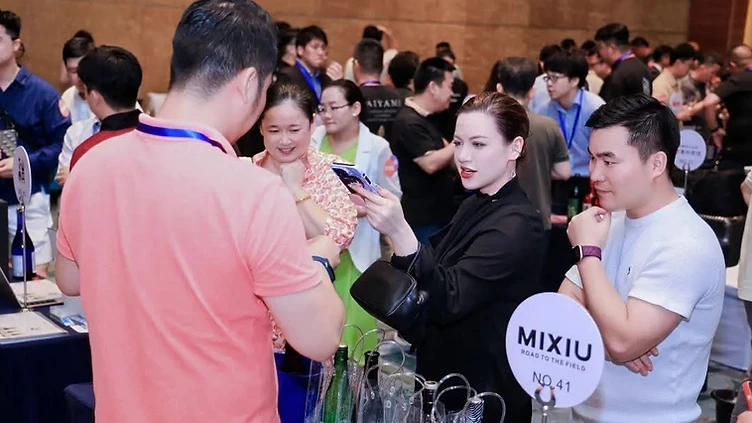
Meeting spaces in Chinese exhibition halls are fast-paced and high-stimulus. A structured 30-minute meeting framework ensures discussions move toward clear commercial outcomes:
00-05 min: Executive introductions, bilingual business card exchange, channel review
05-15 min: Focused comparative portfolio tasting (maximum 3-4 target SKUs)
15-25 min: Commercial terms discussion (pricing architecture, MOQs, incubation support)
25-30 min: Agreement on actionable next steps; WeChat contact confirmation
- Minutes 0–5: Credential Exchange and Context: Exchange physical business cards (presented with both hands) and scan personal WeChat QR codes immediately. Verify the buyer’s core operational footprint.
- Minutes 5–15: Targeted Portfolio Tasting: Avoid pouring your entire range. Present 3 to 4 carefully selected wines that match the buyer's documented price point and channel profile. Emphasize balance, food-pairing synergy, and market trends (such as the rising demand for crisp whites and premium reds highlighted in recent trade analyses).
- Minutes 15–25: Commercial Alignment: Address commercial realities: FOB/EXW pricing tiers, currency arrangements, Minimum Order Quantities (MOQs), and regional exclusivity terms. Be explicit regarding what co-investment or marketing allowances the winery provides for launch activations.
- Minutes 25–30: Next Steps and Scheduling Follow-Up: Agree on concrete deliverables. Whether dispatching commercial samples to their corporate office or scheduling a follow-up review after the fair, record these terms in your shared WeChat dialogue before concluding the session.
Navigating Cultural Nuance and B2B Negotiations
Building commercial partnerships with Chinese wine distributors requires navigating distinct business practices:
- Relationship Foundations (Guanxi): While contract terms and profit margins are paramount, long-term commercial loyalty is built on professional respect, consistency, and face-to-face rapport. Exhibiting consistently demonstrates market commitment.
- Clarity Over Exclusivity: Chinese distributors frequently request immediate national exclusivity during early meetings. Avoid committing to broad exclusivity upfront. Propose regional distribution arrangements or milestone-based exclusivity clauses linked to clear volume targets.
- Decision-Making Cadence: Negotiations often involve internal consensus across multiple business partners. Maintain patience, avoid aggressive high-pressure closes at the booth, and focus on providing precise commercial documentation that the buyer can present to internal stakeholders.
Turning Scheduled Meetings into Long-Term Export Contracts
Securing export growth in China requires converting short exhibition conversations into binding orders. Within 48 hours of meeting conclusion, send bilingual recap summaries via WeChat and email, documenting agreed-upon pricing models, sample requirements, and delivery expectations.
Producers seeking to expand their footprint across southern and mainland China can secure prime placement, access curated buyer networks, and engage pre-qualified importers by registering to Become an Exhibitor at Interwine. Pairing structured advance outreach with leading industry exhibitions establishes a dependable pathway to sustainable commercial success.
Sources
- USDA Foreign Agricultural Service (FAS) - China: Wine Market Update 2025
- General Administration of Customs of the People's Republic of China (GACC) Trade Statistics via ChemLinked
- Beverage Trade Network - China Wine Label and Import Requirements Guide
- MSA Advisory - Wine Market in China: Trends, Growth, and Preferences
Key Takeaways
- —Pre-booking B2B appointments 6 to 10 weeks prior to exhibition start eliminates unvetted traffic and maximizes event ROI.
- —Categorize target buyers across National Importers, Regional Wholesalers, HoReCa, and Omnichannel Retail to tailor pricing and portfolio pitches.
- —Adopt local enterprise communication workflows, utilizing WeChat and bilingual digital sell-sheets rather than relying strictly on email.
- —Qualify buyer credentials prior to confirming meetings, assessing customs clearance capabilities, distribution channels, and volume potential.
- —Structure on-site booth meetings into concise 30-minute commercial sessions focusing on curated tastings and explicit FOB/EXW terms.
- —Avoid granting broad national exclusivity immediately; structure market agreements based on regional territories and performance milestones.
Frequently Asked Questions
When should an international winery begin buyer outreach before exhibiting in China?
Wineries should initiate buyer outreach 8 to 10 weeks prior to the exhibition. This timeline provides sufficient time to research qualified importers, distribute bilingual portfolio materials, coordinate compliant sample logistics, and lock in firm meeting slots on buyer calendars.
Why is email outreach insufficient for securing meetings with Chinese wine buyers?
Commercial B2B workflows in China rely predominantly on WeChat and direct messaging. Emails sent from foreign domains often encounter corporate spam filters, low open rates, and delayed responses. Successful exhibitors establish contact via Enterprise WeChat and mobile channels to ensure rapid communication.
What documentation should wineries prepare before conducting buyer appointments?
Exhibitors should prepare professional Simplified Chinese digital sell-sheets, price lists specifying FOB and EXW terms, details on container loading configurations and MOQs, customs filing codes (such as GACC registration numbers), and third-party critical ratings.
How can wineries avoid non-serious buyers and casual tasters during trade shows?
Implement pre-qualification screening before locking in meeting slots. Inquire about the buyer's distribution channels, current foreign brands handled, and customs clearance setup. Reserve dedicated private tables for pre-scheduled appointments and assign general staff to handle drop-in visitors.
Should a winery agree to national exclusivity during the initial trade show meeting?
No. Wineries should resist committing to broad national exclusivity in early discussions. Instead, negotiate defined regional territories (such as specific provinces or cities) or establish performance-contingent exclusivity clauses tied to agreed container purchase milestones.